LTCOL JOHN J. HEIL, USMC
Lucky Bag Yearbook
From the 1928 Lucky Bag:
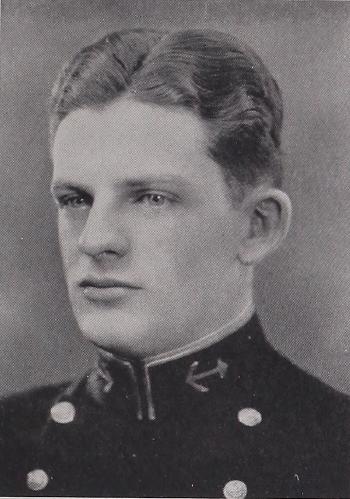
JOHN JOSEPH HEIL
Class Football (4, 2); Class Crew (4, 2); Class Lacrosse (2), Manager (2); Varsity (1); Class Wrestling {4, 5).
JOE spent the earlier days of his life answering the call of the wild-—in Cuba and Washington, D. C. Later, having seen something of the Navy, he spent a star year prepping at Severn, and finally entered the Naval Academy with sails set for a big career on the bounding main.
Even before entrance, this winsome youth was a wrestler of no mean ability, and with consistent effort he has made history. However, it is not all bone-breaking with Joe; he and his saxaphone are always a source of amusement, on board ship as well as in Bancroft Hall.
Blessed with a rare wit, an hospitable nature, and an excellent judgment in all things, Joe is the best of friends. To know him is to appreciate the true depth of his spontaneous good nature and apparently casual existence.
Loss
John was lost on January 19, 1945 when he died of illness and exhaustion caused by his incredible maltreatment as a Prisoner of War. He died while at sea aboard the Brazil Maru.
From Find A Grave:
Lt. Col. John J. Heil was held as a POW in the Philippine Islands. In December 1944, he was boarded onto the Oryoku Maru for transport to Japan. The ship sailed on December 13th and came under attack from American planes on December 14th. As evening approached, the attack was called off. The next day the planes returned and continued the attack. When the pilots saw the large number of men climbing from the ship’s holds, they realized the ship was carrying POWs and called off the attack. After the POWs were off the ship, the attack resumed and the ship was sunk by American planes at Subic Bay, Philippine Islands, on December 15, 1944. The surviving POWs were boarded onto the Enoura Maru which sailed on December 27th and reached Takao, Formosa, by the New Year. While docked it was bombed by American planes on January 9, 1945, killing many of the POWs. The surviving POWs were boarded onto the Brazil Maru which sailed on January 13th. Lt. Col. John J. Heil died on the ship before it reached Japan on January 29, 1945. His body was thrown into the sea.
Other Information
Unable to find any details of John’s service in the Philippines, though he was executive officer of the 2nd Battalion, 4th Marines and was listed as a recipient of a letter of commendation from the Secretary of the Army in Bureau of Naval Personnel Information Bulletin No. 303 (June 1942).
From researcher Kathy Franz:
In 1920, John lived on the Guantanamo Bay Naval Station in Cuba. His father Joseph was a naval officer, mother Mary, brother Cornelius and sisters Teresa and Mary. His father retired as a lieutenant on May 15, 1925.
In August, 1930, John sailed from Port Au Prince, Haiti, to New York City. His residence was listed as 1719 Otis St. NE, Washington, D.C.
John’s wife was Winifred, and in 1940 their children were John Jr., age 9, Margaret, age 8, and Michael, age 4. That year John’s sister Margaret, age 19, lived with them in the Marine Barracks in Quantico.
Prisoner of War Medal
From Hall of Valor:
Major John J. Heil (MCSN: 0-4356), United States Marine Corps, was captured by the Japanese after the fall of Corregidor, Philippine Islands, on 6 May 1942, and was held as a Prisoner of War until his death while still in captivity.
General Orders: NARA Database: Records of World War II Prisoners of War, created, 1942 - 1947
Service: Marine Corps
Rank: Major
Navy Directories & Officer Registers
The "Register of Commissioned and Warrant Officers of the United States Navy and Marine Corps" was published annually from 1815 through at least the 1970s; it provided rank, command or station, and occasionally billet until the beginning of World War II when command/station was no longer included. Scanned copies were reviewed and data entered from the mid-1840s through 1922, when more-frequent Navy Directories were available.
The Navy Directory was a publication that provided information on the command, billet, and rank of every active and retired naval officer. Single editions have been found online from January 1915 and March 1918, and then from three to six editions per year from 1923 through 1940; the final edition is from April 1941.
The entries in both series of documents are sometimes cryptic and confusing. They are often inconsistent, even within an edition, with the name of commands; this is especially true for aviation squadrons in the 1920s and early 1930s.
Alumni listed at the same command may or may not have had significant interactions; they could have shared a stateroom or workspace, stood many hours of watch together, or, especially at the larger commands, they might not have known each other at all. The information provides the opportunity to draw connections that are otherwise invisible, though, and gives a fuller view of the professional experiences of these alumni in Memorial Hall.
July 1928
October 1928
January 1929
April 1929
July 1929
October 1929
January 1930
April 1930
October 1930
January 1931
April 1931
July 1931
October 1931
January 1932
April 1932
October 1932
January 1933
April 1933
July 1933
October 1933
April 1934
October 1934
January 1935
April 1935
October 1935
January 1936
April 1936
July 1936
January 1937
April 1937
September 1937
January 1938
July 1938
January 1939
October 1939
June 1940
November 1940
April 1941
John is one of 15 members of the Class of 1928 on Virtual Memorial Hall.