CDR ROGERS ELLIOTT, USN
Lucky Bag Yearbook
From the 1922 Lucky Bag:
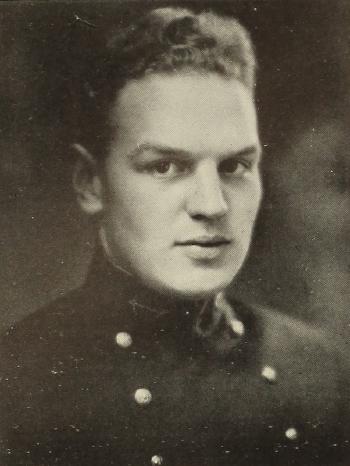
ROGERS ELLIOTT
Crew Squad (4, 3); Class Football Numerals (2).
“OH MY, who is that tall blonde Middy over there, I’d like to meet him”—that’s what all the femmes say about our dimpled, bashful Mellen’s food product. Although “Rog” is a snake of the lowest type, he will tell you that the Sea-Pop’s world revolves around a little manor tucked away in the Palisades of the Hudson.
While “Rog” and work have remained totally unacquainted for three cruises, the Pride of Mayville is a he-man. Plebe and Youngster Year found him on the crew squad, and Second Class Year he was left guard on “Red” Reinicke’s bolsheviki eleven which captured the interclass championship.
The only handicap Rogers has is the fact that he’s “up State.” But the big boy is savvy and has never been known to crack a book (excepting “Red Book,” “Shadowland,” etc.). Non-regness and demos have kept our hero from stars and stripes, but my! my! just cast a glance at the skipper of the First Batt. color guard.
“Oh boy! she’s a wonder!”
“Say, brother, out at second with that stuff!”
Loss
Rogers was lost on October 7, 1943 when USS Concord (CL 10) suffered a gasoline explosion, killing him and 22 other officers and men. He was the ship’s executive officer.
Other Information
From researcher Kathy Franz:
When Rogers joined the Navy in spring 1917, he received a patriotic send-off from the students of Mayville High School with martial music and American flags flying. He was the first resident of Mayville to enter the service since war was declared.
In September, 1919, a dance party was held in his honor at the Odd Fellows hall in Mayville.
Rogers married Marion Blewer in Manhattan on November, 28, 1924.
In September, 1925, Rogers was commander of the R-4 submarine which found the missing navy seaplane PN-9 No. 1 with its five officers and men in Hawaiian waters. The plane was forced down four hours from finishing its San Francisco to Honolulu run. She drifted for nine days before being found off the island of Kauai. The crew had fashioned a sail out of one of the useless wings.
In May, 1927, he and his wife sailed from Honolulu to Wilmington, California. In April, 1930, he was stationed at the Submarine Base in Groton.
When he was promoted to lieutenant commander in May, 1938, he was stationed at Balboa, Canal Zone. In April, 1939, he and his wife and children sailed from Cristobal, Canal Zone, to New York City.
His father Louis was a retail dry goods merchant, mother Mary, brothers Nathaniel and William, and sisters Charlotte and Sarah. Nathaniel attended the Naval Academy, but he did not graduate with the Class of 1927. Brother William passed exams in November, 1922, for the Naval Academy. He attended there and graduated from Drexel University/Institute of Technology. He served in WWII and had the rank of lieutenant commander. He died in 1989 after a long career in Philadelphia life insurance companies.
From Dunkirk (New York) Evening Observer on October 28, 1943:
MAYVILLE NAVAL OFFER, KILLED
Was Serving As Commander With Fleet
Enlisted Soon After Start of World War I.Mayville, Oct. 28–Commander Rogers Elliott, son of Mrs. Mary Elliott of this village and the late Lewis H. Elliott, has been killed in action with the Navy, according to a telegram received from the navy department. It is Mayville’s first death in World War II.
Commander Elliott was 41 years old. He enlisted in the navy on April 23, 1917. He entered the Naval Academy in 1918 and following graduation started service on the U.S.S. Florida.
He was later stationed aboard the submarine, H-4, after which he served four years with the Pacific Fleet in the Hawaiian Islands. Following his return to the states he was sent to Columbia university for an engineering course, graduating from there with a master’s degree.
When the U.S.S. Quincy was floated at Boston he was the first officer on board and was stationed there until transfer to the ill-fated carrier Wasp shortly after it was completed. He served the aircraft carrier as a lieutenant commander, being taken from her while the ship was on Atlantic patrol to be returned to the states and commissioned a commander.
Elliott was on the Wasp when it made its daring dash into the Mediterranean to deliver planes and supplies to Malta only a few weeks before it was sunk in the Pacific.
Commander Elliott is survived by his wife, Mrs. Marion B. Elliott of New London, Conn., two children, Barbara Ann, 15 and Rogers, Jr., 12; his mother, Mrs. Mary Elliott of Mayville; two brothers, N. Y. Elliott, Mayville, and William Elliott, now serving with the Navy at Philadelphia; two sisters, Mrs. G. Ross Morrell of Hornell and Mrs. Robert Simmonds of Corning.
He was a member of William L. Travis Post, American Legion, and Peacock Lodge, F. and A. M., both of Mayville.
His wife was listed as next of kin. He has one memory marker in New York, and another in Arlington National Cemetery.
Navy Directories & Officer Registers
The "Register of Commissioned and Warrant Officers of the United States Navy and Marine Corps" was published annually from 1815 through at least the 1970s; it provided rank, command or station, and occasionally billet until the beginning of World War II when command/station was no longer included. Scanned copies were reviewed and data entered from the mid-1840s through 1922, when more-frequent Navy Directories were available.
The Navy Directory was a publication that provided information on the command, billet, and rank of every active and retired naval officer. Single editions have been found online from January 1915 and March 1918, and then from three to six editions per year from 1923 through 1940; the final edition is from April 1941.
The entries in both series of documents are sometimes cryptic and confusing. They are often inconsistent, even within an edition, with the name of commands; this is especially true for aviation squadrons in the 1920s and early 1930s.
Alumni listed at the same command may or may not have had significant interactions; they could have shared a stateroom or workspace, stood many hours of watch together, or, especially at the larger commands, they might not have known each other at all. The information provides the opportunity to draw connections that are otherwise invisible, though, and gives a fuller view of the professional experiences of these alumni in Memorial Hall.
May 1924
November 1924
January 1925
March 1925
May 1925
July 1925
October 1925
January 1926
October 1926
January 1927
April 1927
October 1927
January 1928
April 1928
July 1928
October 1928
January 1929
April 1929
July 1929
October 1929
January 1930
April 1930
October 1930
January 1931
April 1931
October 1931
January 1932
April 1932
October 1932
January 1933
April 1933
July 1933
October 1933
April 1934
July 1934
October 1934
January 1935
April 1935
January 1936
April 1936
July 1936
January 1937
April 1937
September 1937
January 1938
July 1938
January 1939
October 1939
June 1940
November 1940
April 1941
Rogers is one of 26 members of the Class of 1922 on Virtual Memorial Hall.