LCDR JOHN E. FRENCH, USN
Lucky Bag Yearbook
From the 1922 Lucky Bag:
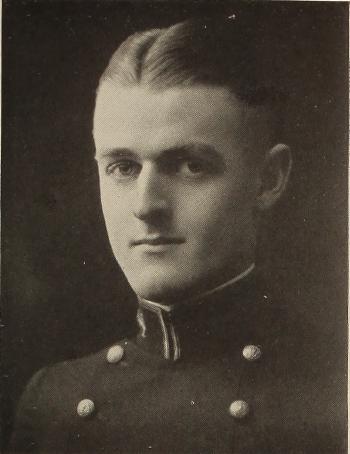
JOHN EDMUND FRENCH
P.A. Squad; Sub Squad (4, 3, 2, 1); Radiator Club; Buzzard (2).
“SKOWHEGAN” and a D. K. E. from Bowdoin, that’s our “Johnny.” Consistently, he has never considered the Academic curriculum as his main object in life; but during his four years he has been able to more than hold his own in the struggle for the 2.5.
He has been one of the mainstays of the Old Radiator Club and during their weekly session at “Doc’s” he was always among those present. His seagoing qualities are unquestioned—being a charter member of that noted Spanish cruising organization.
In the absence of other diversions “Eddie” has taken up fussing in all its phases and by the looks of that nightly mail he has had no little success. Ask anyone about that last night on the dock in San Francisco. However, it has not been these minor mile posts which have been the real events for through it all he has remained true to the “Only One” back in “God’s Country.”
Loss
John was lost on December 7, 1941 when USS Arizona (BB 39) was destroyed during the Japanese attack on Pearl Harbor. He was the ship’s navigator; he had reported aboard in early November.
Other Information
From researcher Kathy Franz:
John was appointed first alternate to the Naval Academy by Congressman Peters in March 1918.
In 1922, his wife-to-be, the former Marion Falkenstein, went to school at the Maryland Institute in Baltimore. Her father was a U. S. Coast Guard officer.
In October 1925, John sailed from Shanghai to Seattle.
John and Marion’s son Donald was born in 1927. In October 1934, the family sailed from Shanghai to Seattle.
John’s father was a mail clerk on the railroad.
His wife was listed as next of kin; he was also survived by a son, Gordon Leigh Smith, a USMC Lieutenant in 1959.
John is buried in Arlington National Cemetery.
Navy Directories & Officer Registers
The "Register of Commissioned and Warrant Officers of the United States Navy and Marine Corps" was published annually from 1815 through at least the 1970s; it provided rank, command or station, and occasionally billet until the beginning of World War II when command/station was no longer included. Scanned copies were reviewed and data entered from the mid-1840s through 1922, when more-frequent Navy Directories were available.
The Navy Directory was a publication that provided information on the command, billet, and rank of every active and retired naval officer. Single editions have been found online from January 1915 and March 1918, and then from three to six editions per year from 1923 through 1940; the final edition is from April 1941.
The entries in both series of documents are sometimes cryptic and confusing. They are often inconsistent, even within an edition, with the name of commands; this is especially true for aviation squadrons in the 1920s and early 1930s.
Alumni listed at the same command may or may not have had significant interactions; they could have shared a stateroom or workspace, stood many hours of watch together, or, especially at the larger commands, they might not have known each other at all. The information provides the opportunity to draw connections that are otherwise invisible, though, and gives a fuller view of the professional experiences of these alumni in Memorial Hall.
January 1924
March 1924
May 1924
July 1924
September 1924
November 1924
January 1925
March 1925
May 1925
October 1925
January 1926
October 1926
January 1927
April 1927
October 1927
January 1928
July 1928
October 1928
January 1929
April 1929
July 1929
October 1929
January 1930
April 1930
October 1930
January 1931
April 1931
July 1931
October 1931
January 1932
April 1932
October 1932
January 1933
April 1933
July 1933
October 1933
April 1934
July 1934
October 1934
January 1935
April 1935
October 1935
January 1936
April 1936
July 1936
January 1937
April 1937
September 1937
January 1938
July 1938
January 1939
October 1939
June 1940
November 1940
April 1941
John is one of 26 members of the Class of 1922 on Virtual Memorial Hall.