CDR JOHNS H. JANNEY, USN
Lucky Bag Yearbook
From the 1936 Lucky Bag:
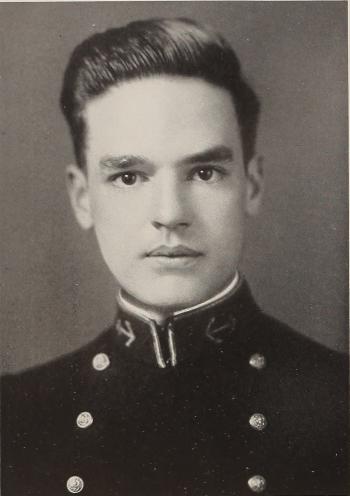
Johns Hopkins Janney
Tennis 4, 3, 2; Third Company Representative 4, 3, 2; Masqueraders 4, 3, 2, 1; President Masqueraders 1; Trident Society 2, 1; Vice-President and Editor-in-Chief of Trident 1; Council N.A.C.A. 1; One Stripe
Loss
Jack was lost in USS Indianapolis (CA 35) when she was sunk by a Japanese submarine on July 30, 1945. He was the ship’s navigator.
Other Information
From the Class of 1936’s “Golden Lucky Bag,” published in 1986 (via Marianne Bradley, daughter of LCDR John Ellis ‘36, USN (Ret.)):
On being commissioned, Jack served in the cruisers New Orleans and Vincennes, and the destroyers Perry and Ballard. In 1942, he was ordered to the Postgraduate School at Annapolis to study electronics and communications. Because of the war, this two year course had been condensed into an intensive 15-month grind. Fellow students recall that Jack was always willing to give a helping hand to his colleagues that were having difficulties.
Upon completion of the course in the summer of 1944, Jack was ordered as Navigator of the cruiser Indianapolis, which shortly became the flagship of Commander Sth Fleet, Vice Admiral Raymond Spruance. In the island hopping campaigns that followed, he saw action at Makin, Tarawa, Kwajalein, Palau, Yap, Ulithi, and Woleai. On 19 June 1944, he navigated the ship in strikes on Iwo Jima and Chichi Jima, known as the Marianas Turkey Shoot.
In February 1945, Indianapolis took part in the carrier task force strike on Tokyo and on following raids on the Japanese home islands and on Okinawa. On 31 March, a kamikaze struck the ship, forcing a return to San Francisco for repairs. On her return to the Pacific in July, she carried nuclear material and equipment for the atomic bombs to be dropped later on Hiroshima and Nagasaki.
On 28 July 1945, Jack and the ship set out on what was to be a final voyage. Ordered to Leyte, the ship departed Guam and was due at her destination three days later. On the night of 29 July, the Japanese submarine I-58 fired six torpedoes at Indianapolis. One hit under No. 1 turret and a second struck under the wardroom. Fifteen minutes later the ship rolled over on her side and sank by the bow. Because of a sudden loss of electrical power, no S.O.S. message was sent. As a result of a communication error, search for the ship was not instituted promptly and it was not until 2 August that a Navy pilot sighted the oil slick and men in the water. Shortly, ships and amphibian planes rescued 316 men. Jack was among the 883 who lost their lives with the war practically over.
From researcher Kathy Franz:
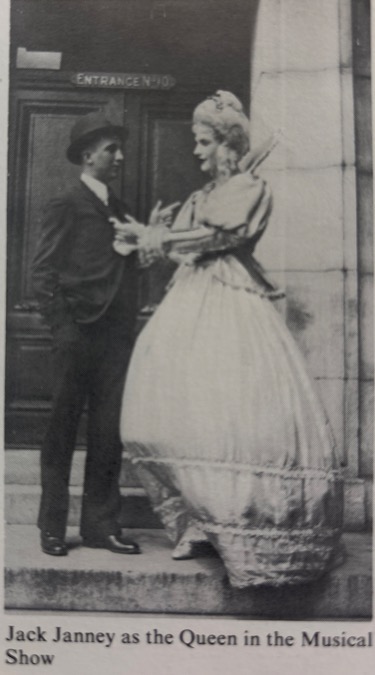
In March 1932, Johns starred in the comedy-melodrama “The Haunted House” produced by the Gilman Country School for Boys Dramatic Association. He had the longest and most difficult role of the novelist. In 1931 he performed in the comedy “Billy.”
His father was listed as next of kin.
Johns is remembered at the Manila American Cemetery and Memorial.
Photographs
Navy Directories & Officer Registers
The "Register of Commissioned and Warrant Officers of the United States Navy and Marine Corps" was published annually from 1815 through at least the 1970s; it provided rank, command or station, and occasionally billet until the beginning of World War II when command/station was no longer included. Scanned copies were reviewed and data entered from the mid-1840s through 1922, when more-frequent Navy Directories were available.
The Navy Directory was a publication that provided information on the command, billet, and rank of every active and retired naval officer. Single editions have been found online from January 1915 and March 1918, and then from three to six editions per year from 1923 through 1940; the final edition is from April 1941.
The entries in both series of documents are sometimes cryptic and confusing. They are often inconsistent, even within an edition, with the name of commands; this is especially true for aviation squadrons in the 1920s and early 1930s.
Alumni listed at the same command may or may not have had significant interactions; they could have shared a stateroom or workspace, stood many hours of watch together, or, especially at the larger commands, they might not have known each other at all. The information provides the opportunity to draw connections that are otherwise invisible, though, and gives a fuller view of the professional experiences of these alumni in Memorial Hall.
July 1936
January 1937
September 1937
January 1938
January 1939
June 1940
November 1940
April 1941
Johns is one of 39 members of the Class of 1936 on Virtual Memorial Hall.