LTJG JOHN G. LITTLE, III, USN
Lucky Bag Yearbook
From the 1935 Lucky Bag:
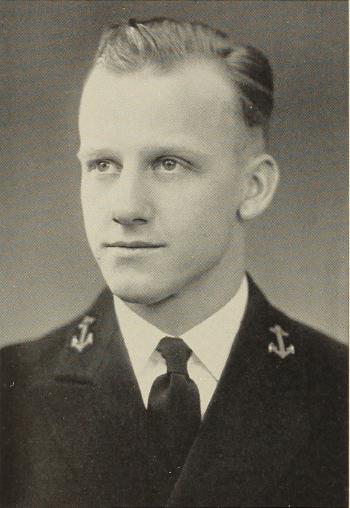
JOHN GRUBBS LITTLE, III
Wrestling 3, 2, 1, Numerals. Reception Committee 1. 2 Stripes.
Loss
John was lost when USS Utah (AG 16) was sunk on December 7, 1941 during the Japanese raid on Pearl Harbor.
Other Information
His wife was listed as next of kin. There is a memorial plaque at the Utah State Capitol building as well as the USS Utah Memorial in Pearl Harbor, HI honoring the 54 men who died on December 7, 1941.

Family
From the July 25, 2014 edition of Ho‘okele:
Lt. j.g. John G. Little III wanted nothing more than to be there when his first child was born. Unfortunately, Little’s wife was on the mainland, and he was unable to make it back home to witness the birth of his son, John G. Little IV.
It would be three months until Little was able to secure leave and return home to see and hold his infant son for the first time. It would also be the last time.
The year was 1941. Lt. j.g. John G. Little III was stationed aboard the USS Utah in Hawaii. His son was born in May of that year. Little held his son for the first time a few months later. On Dec. 7, Lt. j.g. Little was killed during the Japanese attack on Pearl Harbor.
John G. Little IV never knew the man who gave him his name. But that didn’t stop him from taking time out of his Hawaii vacation to visit the USS Utah Memorial on July 17 and pay respects to his fallen father.
Though he never knew him, over the years Little has learned a bit about his late father’s life. It wasn’t always easy.
“My mother wouldn’t talk about him,” he said. “She just dearly loved him. It wasn’t until she passed away that I started to get information from other family members.” “My father was raised by his grandmother after his parents died of an influenza epidemic in Memphis,” Little said.
Little also learned a little about his father’s death at Pearl Harbor.
“When the attack happened, he went on deck to check on his men,” he said. “As he came up to topside was when the strafers hit.”
Of USS Utah’s crew, an estimated six officers and 52 enlisted men were killed during the Dec. 7 attack. The USS Utah Memorial was officially authorized by the 91st Congress in October 1970, and dedicated on Memorial Day 1972. It is located on Ford Island, near the sunken wreckage of the ship.
While he never knew his father, Little has met many of his father’s shipmates.
“I go to USS Utah survivors’ reunions sometimes,” he said. “They all want to tell me their stories. One of them was the mess attendant who served my father’s coffee the morning of the attack.”
While Little was fortunate to have a stepfather he dearly loved, standing at the USS Utah Memorial, he can’t help but think about the parent he lost at a very early age.
“I was six months old when he died,” he said, looking out at the wreckage of the Utah. “I wish I’d known my father. He’s still down there."
Navy Directories & Officer Registers
The "Register of Commissioned and Warrant Officers of the United States Navy and Marine Corps" was published annually from 1815 through at least the 1970s; it provided rank, command or station, and occasionally billet until the beginning of World War II when command/station was no longer included. Scanned copies were reviewed and data entered from the mid-1840s through 1922, when more-frequent Navy Directories were available.
The Navy Directory was a publication that provided information on the command, billet, and rank of every active and retired naval officer. Single editions have been found online from January 1915 and March 1918, and then from three to six editions per year from 1923 through 1940; the final edition is from April 1941.
The entries in both series of documents are sometimes cryptic and confusing. They are often inconsistent, even within an edition, with the name of commands; this is especially true for aviation squadrons in the 1920s and early 1930s.
Alumni listed at the same command may or may not have had significant interactions; they could have shared a stateroom or workspace, stood many hours of watch together, or, especially at the larger commands, they might not have known each other at all. The information provides the opportunity to draw connections that are otherwise invisible, though, and gives a fuller view of the professional experiences of these alumni in Memorial Hall.
October 1935
January 1936
April 1936
September 1937
January 1938
July 1938
October 1939
June 1940
November 1940
April 1941
John is one of 56 members of the Class of 1935 on Virtual Memorial Hall.