LCDR EDWARD C. METCALFE, USN
Lucky Bag Yearbook
From the 1922 Lucky Bag:
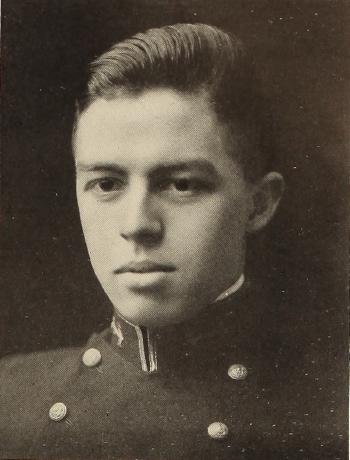
EDWARD CONRAD METCALFE
Log Staff (4, 3, 2, 1); Lucky Bag; Black N******; Probation (2).
“CHASE me, Oi’m a Yiddish butterfly,” cooed a gay young thing at Coney Island the minute she cast her “ojos” on this he-vamp. Yes, we repeat, he-vamp, for he shakes a mean calf—but he’s a much meaner slinger of the bull. His line would make Captain Billy sound like Emerson. It holds in any clime, too. If you want to make the color of his face rival those scarlet locks just ask about a certain Western cabaret or mention the “hoosgow” in Panama. Still, one must remember, “the blush is the symbol of innocence.”
Early Second Class Year “Red” stubbed his toe, as it were, on a Plebe’s cap, and was only saved from emulating Balaam’s departure from Jerusalem by the grace of God and the old reliable line.
We can’t do justice to this man in print, and besides, that look of reform on his childish face leaves us without the heart we can’t even use his own favorite expression, “It’s a shame he drinks.”
Loss
Edward was lost when USS Quincy (CA 39) was sunk early in the morning of August 9, 1942 by Japanese surface forces at the Battle of Savo Island. He was the ship’s navigator.
Other Information
From researcher Kathy Franz:
Edward preferred to go by his middle name, Conrad. He graduated from the Natchez Institute High School in May 1916.
At his high school commencement, Edward gave the oration speech, “The Advantages of Living in Mississippi.” The Natchez Democrat printed his speech on May 28, 1916. In part, it began: “Mississippi State, the pearl of the Mississippi Valley, is of peculiar importance today. Surging ahead as leader of the New South, she is causing the whole nation to pause and wonder.” It ended: “As she stands upright, full-statured and equal among the peoples of the earth, she realizes that much of her strength and prosperity has been acquired by the unceasing efforts and progressive activities of Mississippi’s patriots and statesmen, and filled with grateful pride lays her laurels before the state of undeveloped resources, the state of spiritual and intellectual progress, the state of love and freedom. – the state of Mississippi.” E. Conrad Metcalfe.
In December, 1916, he came from Poughkeepsie, New York, to Natchez for Christmas.
To prepare for the Naval Academy, Edward went to Washington, D. C., in the summer of 1918.
In January 1923, the newspaper reported that his name along with over 500 other white WWI ex-service persons would be engraved on the Adams County Memorial Hall tablets, now part of the federal courthouse. In 2011, more than 100 white veterans and 581 black veterans were added to the bronze plaques.
Edward married Mrs. Agnes (Ashford) Robert on September 1, 1930, at the Church of the Covenant in Washington, D. C. His best man was Lt. Vaughan Michaux (’22.) In attendance was Daisy Reed, granddaughter of Col. Walter Reed.
Agnes’ father was Snowden Ashford known as the “Architect of the Everyday.” He was the first municipal architect Washington, D. C., and he had many structures to his credit between 1895 and 1921. In June 1924, Agnes married Ensign Robert P. Robert (’23,) but they later divorced.
Edward’s father James Montrose was a retail merchant for coal. His mother was Agnes, brothers James and Orrick, and sister Agnes. They lived at 305 S. Broadway, Natchez. This is a parsonage built in 1852 that is now on the National Historic Register.
Edward has a memory marker in Mississippi.
His wife was listed as next of kin; he was also survived by a son, Jim (USNA ‘63).
Navy Directories & Officer Registers
The "Register of Commissioned and Warrant Officers of the United States Navy and Marine Corps" was published annually from 1815 through at least the 1970s; it provided rank, command or station, and occasionally billet until the beginning of World War II when command/station was no longer included. Scanned copies were reviewed and data entered from the mid-1840s through 1922, when more-frequent Navy Directories were available.
The Navy Directory was a publication that provided information on the command, billet, and rank of every active and retired naval officer. Single editions have been found online from January 1915 and March 1918, and then from three to six editions per year from 1923 through 1940; the final edition is from April 1941.
The entries in both series of documents are sometimes cryptic and confusing. They are often inconsistent, even within an edition, with the name of commands; this is especially true for aviation squadrons in the 1920s and early 1930s.
Alumni listed at the same command may or may not have had significant interactions; they could have shared a stateroom or workspace, stood many hours of watch together, or, especially at the larger commands, they might not have known each other at all. The information provides the opportunity to draw connections that are otherwise invisible, though, and gives a fuller view of the professional experiences of these alumni in Memorial Hall.
July 1923
November 1923
January 1924
September 1924
January 1926
October 1926
January 1927
April 1927
October 1927
January 1928
April 1928
July 1928
October 1928
January 1929
July 1929
October 1929
January 1930
April 1930
October 1930
January 1931
April 1931
July 1931
October 1931
July 1934
October 1934
January 1935
April 1935
October 1935
January 1936
April 1936
July 1936
January 1937
April 1937
September 1937
January 1938
July 1938
January 1939
October 1939
June 1940
November 1940
April 1941
Edward is one of 26 members of the Class of 1922 on Virtual Memorial Hall.