CAPT RANDOLPH B. BOYER, USN
Lucky Bag Yearbook
From the 1927 Lucky Bag:
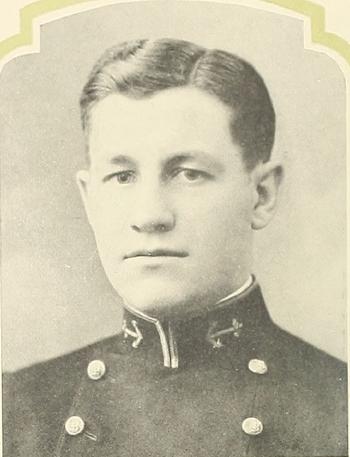
Randolph Burton Boyer
Track: A Squad (3, 2, 1) Class (4) Navy Numerals (4, 3, 2); Soccer: A Squad (3, 2, 1) Block N (1) Class (4) Navy Numerals (4, 3, 2); Boxing: A Squad (3, 2) Class (4) Navy Numerals (2).
BEHOLD! It is our athlete, and the peer of vamps. Beware, young ladies, for he has the old Navy line. His motto is, “A girl in every port and three at home.”
“The Kid” from the first time he arrived at Annapolis, has always gone out for the toast. As a soccer player, he is hard to beat,—and such a slender fellow! But is he hard? Ask any Penn State man who played against him his Youngster year. He is also one of “Spike’s” fearless battlers; and he hurdles on the track team.
“Rannie” is mighty consistent in the academics. Although never starring, he always has plenty to spare. “My, I am likely to go unsat in Calc.”
He has a tremendous attraction to everyone. He is forever helping his roommates. You should hear those two argue. There is nothing they do not talk about, and many Baltimoreans are said to have obtained pointers on Darwin’s theory or the like from their low conversations.
“Rannie” has those underlying qualities that show the true hard-fighting type, and we know he will go forth to conquer new worlds. A true friend to all, never moody, never cross, we all like him and find him a true classmate and companion.
Loss
Randolph was lost on August 16, 1947 when the converted B-17 he was aboard crashed while approaching Naval Air Station Barber’s Point, Hawaii.
Nine others were also killed, including Ambassador George C. Atcheson, Jr., the chief political advisor and the chairman of the allied powers council in Japan. He was a member of “General MacArthur’s strategic and operations staff;” the plane had left Tokyo and the entourage was on its way to Washington, D.C. for consultations with the State Department. (Correction to the direction of travel and purpose of the trip from David Boyer on June 30, 2025.)
Other Information
From researcher Kathy Franz:
The plane radioed that they were out of fuel. The three survivors were picked up by the Hermes and transferred to the destroyer Rowan. His friend Captain Roy Gano (‘26) discovered Randolph’s body on the foredeck of the ship. They were both from Minnesota and served together until a year prior.
On October 4, 1929, in Portsmouth, Virginia, Randolph married Harriett Chandlee Chadwick, daughter of Captain D. V. Chadwick, U. S. N. In August 1945, he spent several days with her at their home in Staunton, Virginia. Their daughters were Alice and Patricia “Patsy.”
In January 1943, Randolph received the Navy Cross for rescuing 51 survivors in October 1942. As part of Destroyer Squadron Two, he rescued 1,000 off the Lexington and the Yorktown in the battle of Coral Sea and at Midway.
In March 1943, he was in San Francisco on his way to Washington, D. C. In May, he attended the Hunter Trials staged by the Glenmore Hunt club at the Rohr farm in Staunton, Virginia.
Randolph, his wife and guests attended the Navy-Notre Dame game in Baltimore in November 1946.
His father John was a farmer. In 1910, his brothers were Philip and John, and their sisters were Esther and Helen.
From the Daily News Leader, Staunton, Virginia, December 14, 1944 via researcher Kathy Franz:
NORFOLK, Dec. 14—Commander Randolph B. Boyer, USN, of Staunton, Va., has been awarded the Bronze Star Medal for distinguished services connected with assault operations, the Fifth Naval District here was advised today.
His medal is accompanied by a citation which says: “Commander Boyer skillfully organized the facilities and trained the operating personnel of the joint operations rooms in the amphibious flagship, thereby providing efficient and accurate means by which effective control of the large scale amphibious forces was exercised.
“His reliable and tireless efforts in maintaining up-to-date records of ship locations, convoy movements and special operations missions, and his efficient administration of these forces, contributed materially to the success of the assault and proper maintenance of the occupying armies.”
From The Daily News Leader, Staunton, January 16, 1947 via researcher Kathy Franz:
Capt. Randolph Barton Boyer, USN, husband of Mrs. Harriet Chandlee Boyer, Washington, D. C., has received a permanent citation for the Bronze Star Medal from Secretary of the Navy James Forrestal, for the President. Mrs. Boyer resided in Staunton several years while her husband was away at war.
Capt. Boyer, currently serving in the Navy Department, Washington, D. C., received the award for his service as operations officer on the staff of a naval task force commander, prior to and during the invasion of Southern France.
Randolph was survived by his wife, daughter, mother, two sisters, and two brothers. He is buried in Arlington National Cemetery.
Navy Cross
From Hall of Valor:
The President of the United States of America takes pleasure in presenting the Navy Cross to Lieutenant Commander Randolph Burton Boyer, United States Naval Reserve, for extraordinary heroism and distinguished service in the line of his profession as Commanding Officer of the Destroyer U.S.S. MORRIS (DD-417), during the engagement with enemy Japanese forces north of the Santa Cruz Islands on 26 October 1942. After enemy bombs and torpedoes had seriously damaged the task force carrier resulting in raging fires and a dangerous list on that vessel, Lieutenant Commander Boyer skillfully brought his ship alongside in a most seamanlike manner to assist in fighting fires on board with every means at his command. Although driven away by further enemy air attacks, he repeatedly returned to the side of the stricken carrier to continue rendering effective assistance. Later he maneuvered in the vicinity of the ship to evacuate and rescue survivors. His gallantry and intrepidity in action were in keeping with the highest traditions of the Naval Service.
General Orders: Commander Southern Pacific Fleet: Serial 0029 (January 7, 1943)
Service: Navy
Rank: Lieutenant Commander
Though the citation above says he was a member of the reserves, he was on the active list per the Register of Commissioned and Warrant Officers of the United States Navy and Marine Corps of 1947.
Bronze Star
Unable to find a citation for the Bronze Star listed on his headstone.
Navy Directories & Officer Registers
The "Register of Commissioned and Warrant Officers of the United States Navy and Marine Corps" was published annually from 1815 through at least the 1970s; it provided rank, command or station, and occasionally billet until the beginning of World War II when command/station was no longer included. Scanned copies were reviewed and data entered from the mid-1840s through 1922, when more-frequent Navy Directories were available.
The Navy Directory was a publication that provided information on the command, billet, and rank of every active and retired naval officer. Single editions have been found online from January 1915 and March 1918, and then from three to six editions per year from 1923 through 1940; the final edition is from April 1941.
The entries in both series of documents are sometimes cryptic and confusing. They are often inconsistent, even within an edition, with the name of commands; this is especially true for aviation squadrons in the 1920s and early 1930s.
Alumni listed at the same command may or may not have had significant interactions; they could have shared a stateroom or workspace, stood many hours of watch together, or, especially at the larger commands, they might not have known each other at all. The information provides the opportunity to draw connections that are otherwise invisible, though, and gives a fuller view of the professional experiences of these alumni in Memorial Hall.
January 1928
April 1928
July 1928
October 1928
January 1929
April 1929
July 1929
October 1929
January 1930
April 1930
October 1930
January 1931
April 1931
July 1931
October 1931
January 1932
April 1932
October 1932
January 1933
April 1933
July 1933
October 1933
April 1934
July 1934
October 1934
January 1935
April 1935
October 1935
January 1936
April 1936
July 1936
January 1937
April 1937
September 1937
January 1938
July 1938
January 1939
October 1939
June 1940
November 1940
April 1941
Randolph is one of 41 members of the Class of 1927 on Virtual Memorial Hall.