LT ROSCOE F. DILLEN, JR., USN
Lucky Bag Yearbook
From the 1935 Lucky Bag:
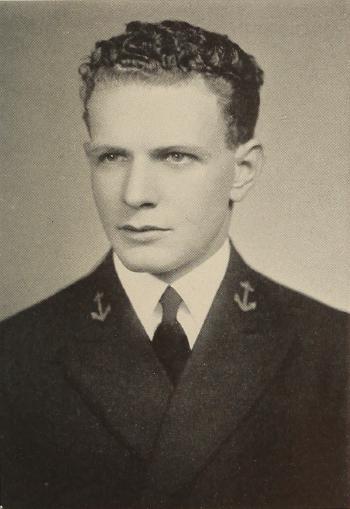
ROSCOE FRANKLIN DILLEN JR.
Tennis 4, 3, 2, 1, Numeral. Wrestling 4, 2, Numeral. Class Water Polo. 2 Stripes. Star.
Loss
Roscoe was lost when USS Shark (SS 174) was sunk, possibly on February 11, 1942, by a Japanese destroyer. He was the boat’s executive officer.
Other Information
From researcher Kathy Franz:
Roscoe attended Western High School in Washington, D.C., in 1930. Cadets ’28, ’29, ’30; En Avant ’30; Stamp Club ’27, ’28, ’29. Company L, Third Battalion. Known as – Roscoe. Is – Serious, military and mature. Famous for – Having curly hair and being quite a ladies’ man. He also attended Columbian Prep school in Washington.
He was also survived by his mother and brother Goodwin. He married his wife, the former Alice Elizabeth Meyers, in Honolulu in 1940.
His father was a career naval officer, Naval Academy graduate Class of 1904, and commanded USS West Virginia (BB 48) from 1934-1936.
Note: Unclear why Roscoe’s name appears where it does on his class’ panel in Memorial Hall. His classmate, Edwin Denby, Jr. ‘35, who was also lost in Shark, appears fifteen names earlier and in the correct place chronologically.
His wife was listed as next of kin.
Navy Directories & Officer Registers
The "Register of Commissioned and Warrant Officers of the United States Navy and Marine Corps" was published annually from 1815 through at least the 1970s; it provided rank, command or station, and occasionally billet until the beginning of World War II when command/station was no longer included. Scanned copies were reviewed and data entered from the mid-1840s through 1922, when more-frequent Navy Directories were available.
The Navy Directory was a publication that provided information on the command, billet, and rank of every active and retired naval officer. Single editions have been found online from January 1915 and March 1918, and then from three to six editions per year from 1923 through 1940; the final edition is from April 1941.
The entries in both series of documents are sometimes cryptic and confusing. They are often inconsistent, even within an edition, with the name of commands; this is especially true for aviation squadrons in the 1920s and early 1930s.
Alumni listed at the same command may or may not have had significant interactions; they could have shared a stateroom or workspace, stood many hours of watch together, or, especially at the larger commands, they might not have known each other at all. The information provides the opportunity to draw connections that are otherwise invisible, though, and gives a fuller view of the professional experiences of these alumni in Memorial Hall.
October 1935
January 1936
April 1936
July 1936
January 1937
April 1937
September 1937
January 1939
October 1939
November 1940
April 1941
Roscoe is one of 56 members of the Class of 1935 on Virtual Memorial Hall.