LT THOMAS F. MALONE, USN
Lucky Bag Yearbook
From the 1941 Lucky Bag:
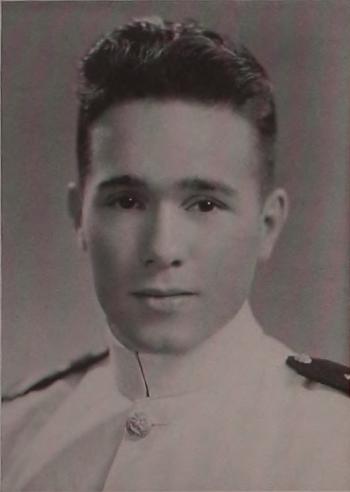
THOMAS FRANCIS MALONE
Boat Club 2, 1; Battalion Wrestling. 4, 3, 2.
Loss
Thomas was lost when USS Boyd (DD 544) was damaged by Japanese shore batteries during an attempted rescue of a downed aircrew near Nauru Island on December 7, 1942. He was the only officer lost; 11 men were also killed and 8 wounded.
From Destroyers.org:
At 1033 while returning to form up with carrier group BOYD left formation as ordered by Commander Task Group 50.8 to pick up survivors of a plane crash first reported 12 miles southwest of island. At 1038 a raft was reported in position 2 miles west of island. During approach, a plane reported to CTG (Commander Task Group) 50.8 who direct BOYD to proceed on assigned rescue and 3 planes were ordered to assist in the search. At 1130 plane dropped smoke float near raft, and BOYD made approach. At 1125 a lookout reported object in water, which looked like a man waving his hand in the air. At 1140 BOYD stopped between life raft, which was carrier plane type and upside down, and the island; object was identified as smoke float or float light. At 1142 two shells hit the ship, on exploding in forward engine room, shearing or puncturing all steam lines and main power distribution board, the second exploding inside #1 stack. BOYD immediately commenced maneuvering radically (chasing salvos) and began counter battery fire using manual control. In retiring, ship was straddled at least five times, the second four gun salvo exploding close aboard to port damaging guns 24 and 26 and piercing an air flask of an after torpedo. In this attack all personnel of the forward engine room, with the exception of one MM2 who was seriously burned, were killed. Damage control measures were taken to plug the hole in the side and pump water from the forward engine room space. Total casualties were one officer and 11 men killed, 8 wounded. Burial of 10 of these was held on 9 December. Two died later after transfer to ALABAMA and were interred at Espiritu Santo.
Other Information
From researcher Kathy Franz:
Thomas graduated from Madison high school in 1936. He attended the University of Nebraska for one year where he was a private in Company B, Engineers.
In August 1942 while serving off the east coast with headquarters at Norfolk, Virginia, Thomas was promoted to the rank of Lieutenant (j.g.)
He married Barbara McDonald on January 19, 1943, at Our Lady of Victory Chapel in Norfolk. The wedding was attended by Admiral Ritchie and officers of the U. S. S. Hogan. After a trip to Madison, he was sent to the west coast for service as chief engineer on a destroyer.
His daughter Marjorie Ellen Malone was born October 29, 1943, whom he had never seen.
His father Frank was a farmer, mother Mary, two sisters Mrs. Rosemary Lubischer and Margaret, and two brothers S-Sgt. Patrick Malone and Edmund.
His wife was listed as next of kin. Thomas is remembered at the Courts of the Missing in Hawaii.
Photographs
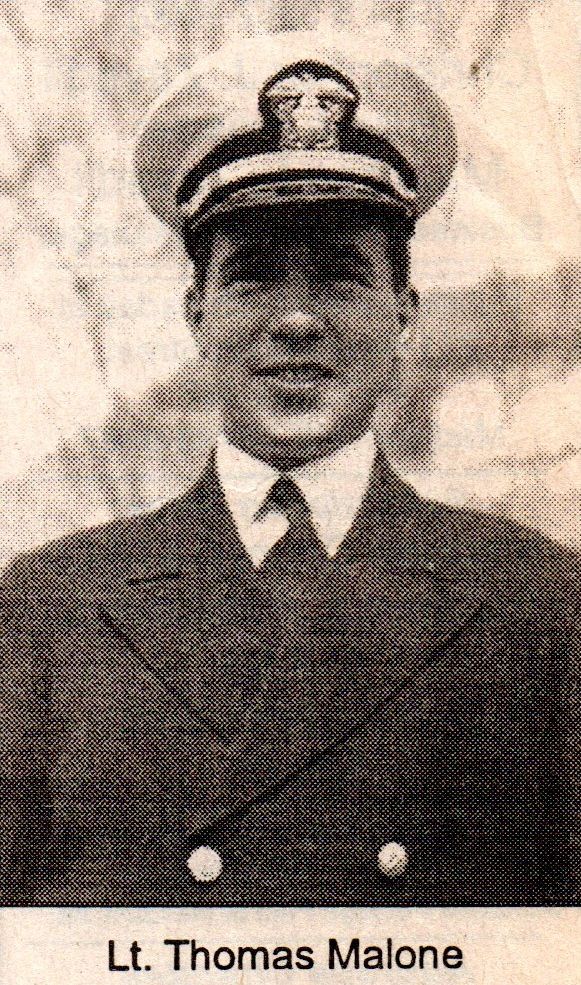
Navy Directories & Officer Registers
The "Register of Commissioned and Warrant Officers of the United States Navy and Marine Corps" was published annually from 1815 through at least the 1970s; it provided rank, command or station, and occasionally billet until the beginning of World War II when command/station was no longer included. Scanned copies were reviewed and data entered from the mid-1840s through 1922, when more-frequent Navy Directories were available.
The Navy Directory was a publication that provided information on the command, billet, and rank of every active and retired naval officer. Single editions have been found online from January 1915 and March 1918, and then from three to six editions per year from 1923 through 1940; the final edition is from April 1941.
The entries in both series of documents are sometimes cryptic and confusing. They are often inconsistent, even within an edition, with the name of commands; this is especially true for aviation squadrons in the 1920s and early 1930s.
Alumni listed at the same command may or may not have had significant interactions; they could have shared a stateroom or workspace, stood many hours of watch together, or, especially at the larger commands, they might not have known each other at all. The information provides the opportunity to draw connections that are otherwise invisible, though, and gives a fuller view of the professional experiences of these alumni in Memorial Hall.
April 1941
Thomas is one of 60 members of the Class of 1941 on Virtual Memorial Hall.