LT TED A. HILGER, USN
Lucky Bag Yearbook
From the 1935 Lucky Bag:
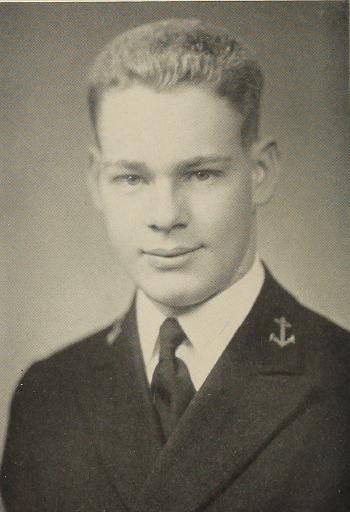
TED ADAIR HILGER
M.P.O
Loss
Ted was lost when USS Pillsbury (DD 227) was sunk, with the loss of all hands, by a superior Japanese surface force in a night action on March 2, 1942, 200 miles east of Christmas Island in the Indian Ocean.
Other Information
From researcher Kathy Franz:
Ted graduated in 1930 from Sherman High School. “Always ready to lend a helping hand.” Scholarship (Honor Society) ’27, ’28, ’29, ’30; Secretary ‘30; Junior Jesters ’29; Hi-Y ’29, Secretary ’30; Treasurer Circulus Intimus (Latin club) ’30; Hi-Talk newspaper (sports editor) ’28, ’29, ’30. His method? H2O2, too.
In June 1930, Ted was one of 58 Texas boys who took competitive examinations for the Thomas A. Edison scholarship. He was one of six who made the finals. He attended Texas A&M College before entering the Naval Academy.
In 1920 father John was a stone cutter in a marble yard; mother Emma, brothers Rothe, George and Jack. In 1930 his mother was a dietician in the school cafeteria, Rothe was an engineer working for the telephone company, and George was doing electrical work.
From Find A Grave: “Born about 1913, Ted Adair Hilger was the son of John Fredrick Hilger and Emma Dye.”
His mother was listed as next of kin.
Ted was a “Language/Cultural Officer” who spent some amount of time in Japan in 1941.
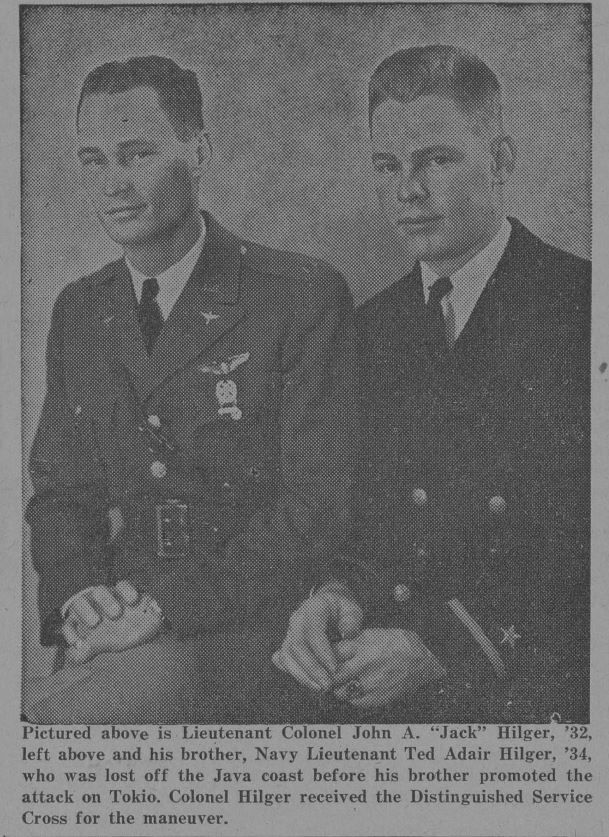
Photographs
Navy Directories & Officer Registers
The "Register of Commissioned and Warrant Officers of the United States Navy and Marine Corps" was published annually from 1815 through at least the 1970s; it provided rank, command or station, and occasionally billet until the beginning of World War II when command/station was no longer included. Scanned copies were reviewed and data entered from the mid-1840s through 1922, when more-frequent Navy Directories were available.
The Navy Directory was a publication that provided information on the command, billet, and rank of every active and retired naval officer. Single editions have been found online from January 1915 and March 1918, and then from three to six editions per year from 1923 through 1940; the final edition is from April 1941.
The entries in both series of documents are sometimes cryptic and confusing. They are often inconsistent, even within an edition, with the name of commands; this is especially true for aviation squadrons in the 1920s and early 1930s.
Alumni listed at the same command may or may not have had significant interactions; they could have shared a stateroom or workspace, stood many hours of watch together, or, especially at the larger commands, they might not have known each other at all. The information provides the opportunity to draw connections that are otherwise invisible, though, and gives a fuller view of the professional experiences of these alumni in Memorial Hall.
September 1937
July 1938
January 1939
October 1939
November 1940
April 1941
Ted is one of 56 members of the Class of 1935 on Virtual Memorial Hall.