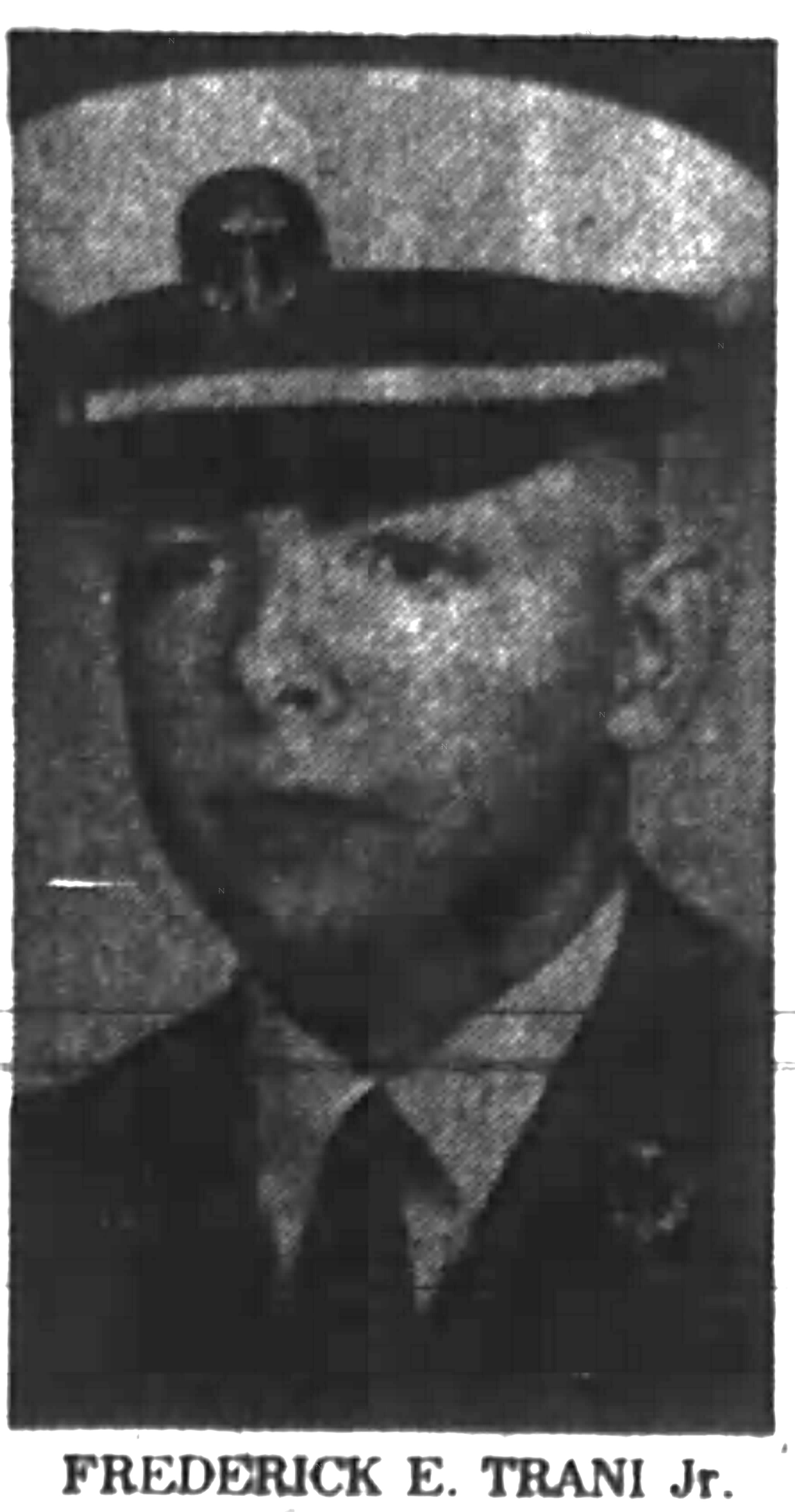
LT FREDERICK E. TRANI, USN
Lucky Bag Yearbook
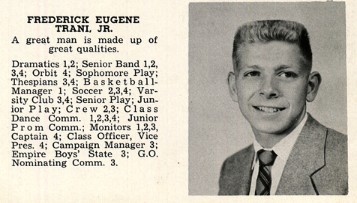
From the 1963 Lucky Bag:
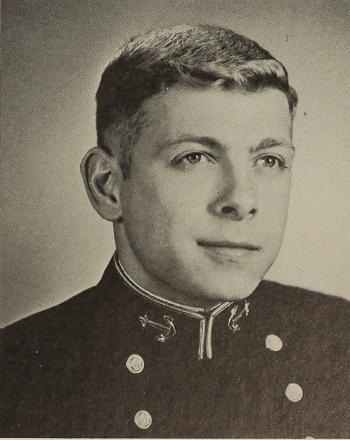
FREDERICK EUGENE TRANI
Loss
Frederick died on September 26, 1968 of wounds suffered while on a combat patrol in South Vietnam. He was a Navy SEAL assigned as an advisor to the Vietnamese Navy.
Other Information
From the December 1968 issue of Shipmate:
Lt. Frederick E. Trani, Jr., USN, died 26 Sept. at the 24th Evacuation Hospital, Long Binh, South Vietnam, as the result of wounds sustained while on combat patrol. He was a member of the Seals assigned to Commander Naval Support Activity Saigon.
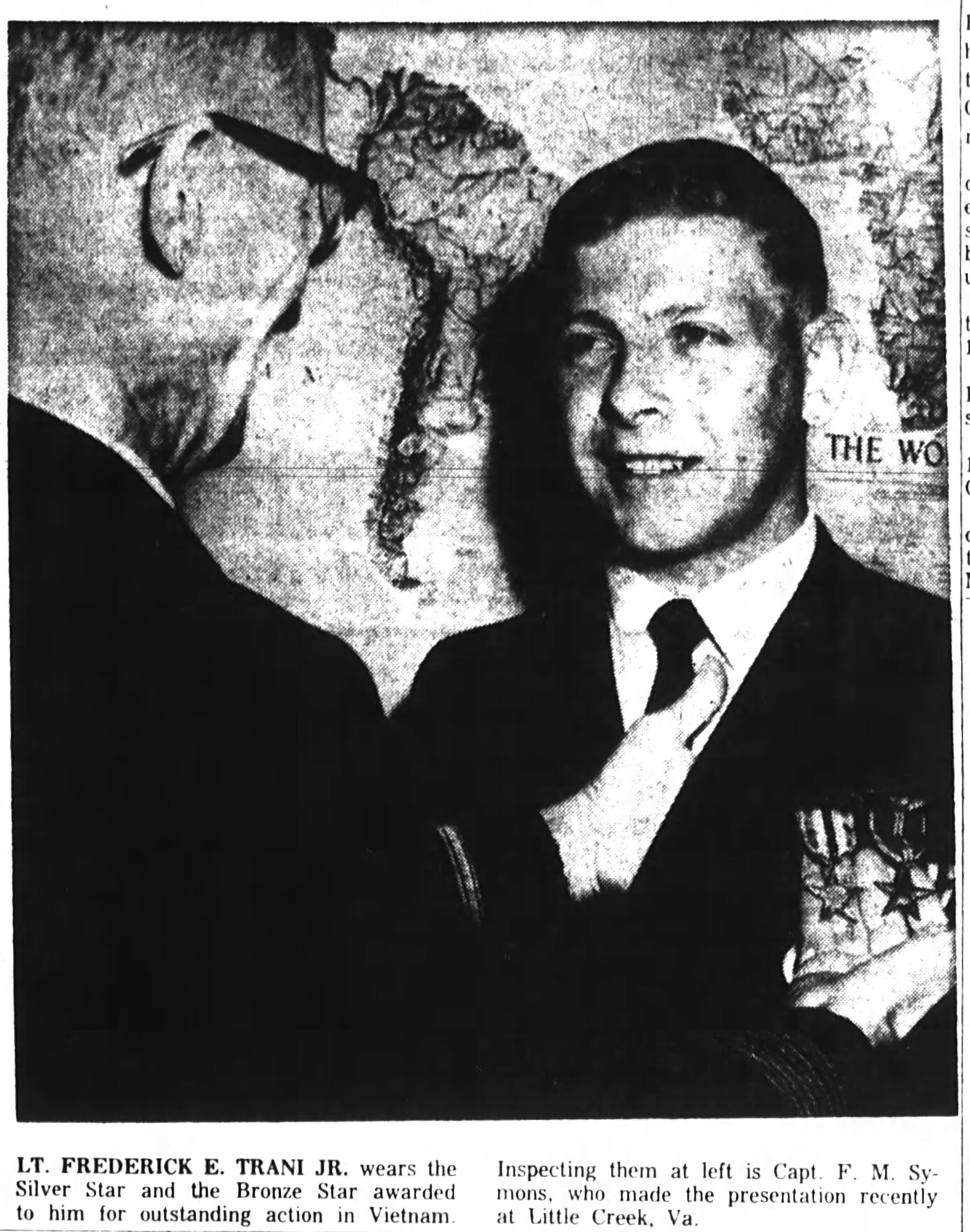
Lt. Trani was born in Lowville, N.Y. He enlisted in the Navy and was an honor man at Great Lakes Naval Training Station, Ill., prior to his appointment to the Naval Academy; he was graduated in 1963. His first assignment was in USS Fechteler, which received a citation for its role in the Tonkin Gulf incident that brought about the U.S. military buildup in Vietnam. Following training in the Seal program, he was assigned to Vietnam and received the Silver Star and Legion of Merit last year for outstanding services. He had been in Vietnam for this second tour of duty since late May.
Surviving are his widow, Gertrude, of 13 Red Barn Road, Hyde Park, N. Y. 12538; a son, Christopher, and daughter, Catherine Ann; his parents, Mr. Frederick Eugene Trani, district supervisor of special services in the Hyde Park Central School District, and Mrs. Trani of 18 Valley View Road, Hyde Park, N.Y. 12538.
From researcher Kathy Franz:
Frederick graduated from Roosevelt High School in 1957. He played Sgt. Chuck Vincent in the class play “Dear Ruth” and Dexter Franklin in the comedy “Meet Corliss Archer.”
He then attended Union College in Schenectady.
Frederick was hurt in a head-on car accident on January 3, 1958 in a three-vehicle accident in Hyde Park.
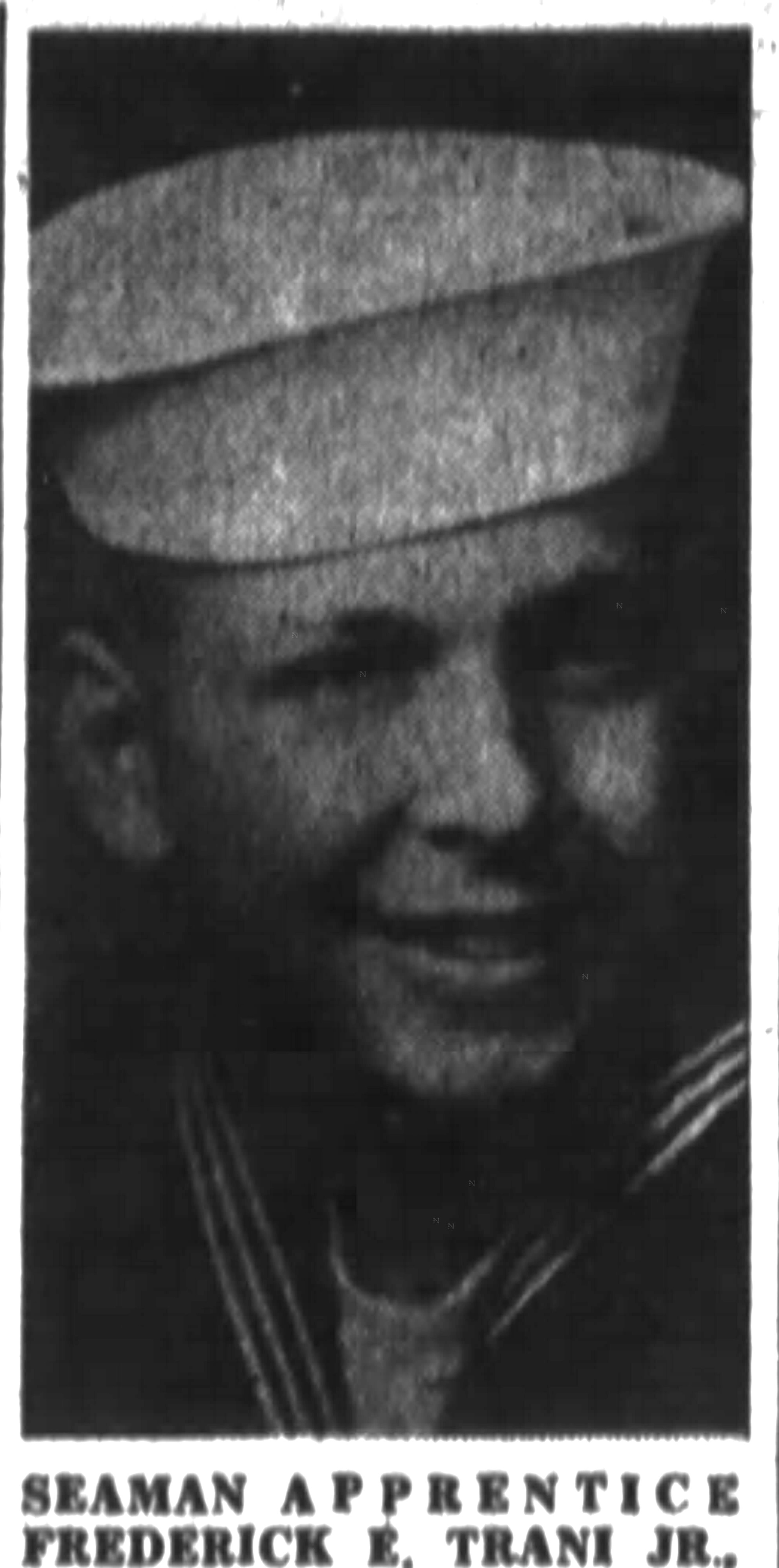
He was selected as honor man of Company 107 at the United States Naval Training Center In Great Lakes in May, 1958. He received a certificate of honor and an engraved silver identification bracelet at recruit graduation.
Frederick then attended electronics school at the training center, and he was first among 69 candidates who took the Bainbridge Preparatory school examination.
His summer cruise in 1962 was aboard the submarine USS Argonaut. He then trained at the Army Infantry school in Fort Benning and completed the airborne course which qualified him to wear the parachutist badge.
Frederick married Gertrude Daley, a former high school classmate, on July 21, 1963, at St. Peter’s church. Peter Barth was his best man.
In December 1964, Frederick spoke about his experiences with the Navy Seventh Fleet in the Pacific to Naval Reserve members. He was aboard the U.S.S. Fechteler in the Pacific, and her crew received a commendation for the Tonkin Gulf incident.
Frederick then reported to Little Creek, Virginia, for amphibious training. After graduating from its Underwater Demolition Team replacement course, he took three weeks of airborne training at Fort Benning.
He then finished five weeks of advanced swimming at Key West and reported to a UDT unit at the Little Creek Amphibious Base in July 1965.
After undergoing demolition training, he went into the Seal program, and in early June 1967, he went to South Vietnam.
His father was a junior high principal and a Naval Reserve commander. His maternal grandfather was Professor Alexander Dillingham who was a former instructor in mathematics at the Naval Academy.
From the Poughkeepsie Journal (New York) on September 4, 1962:
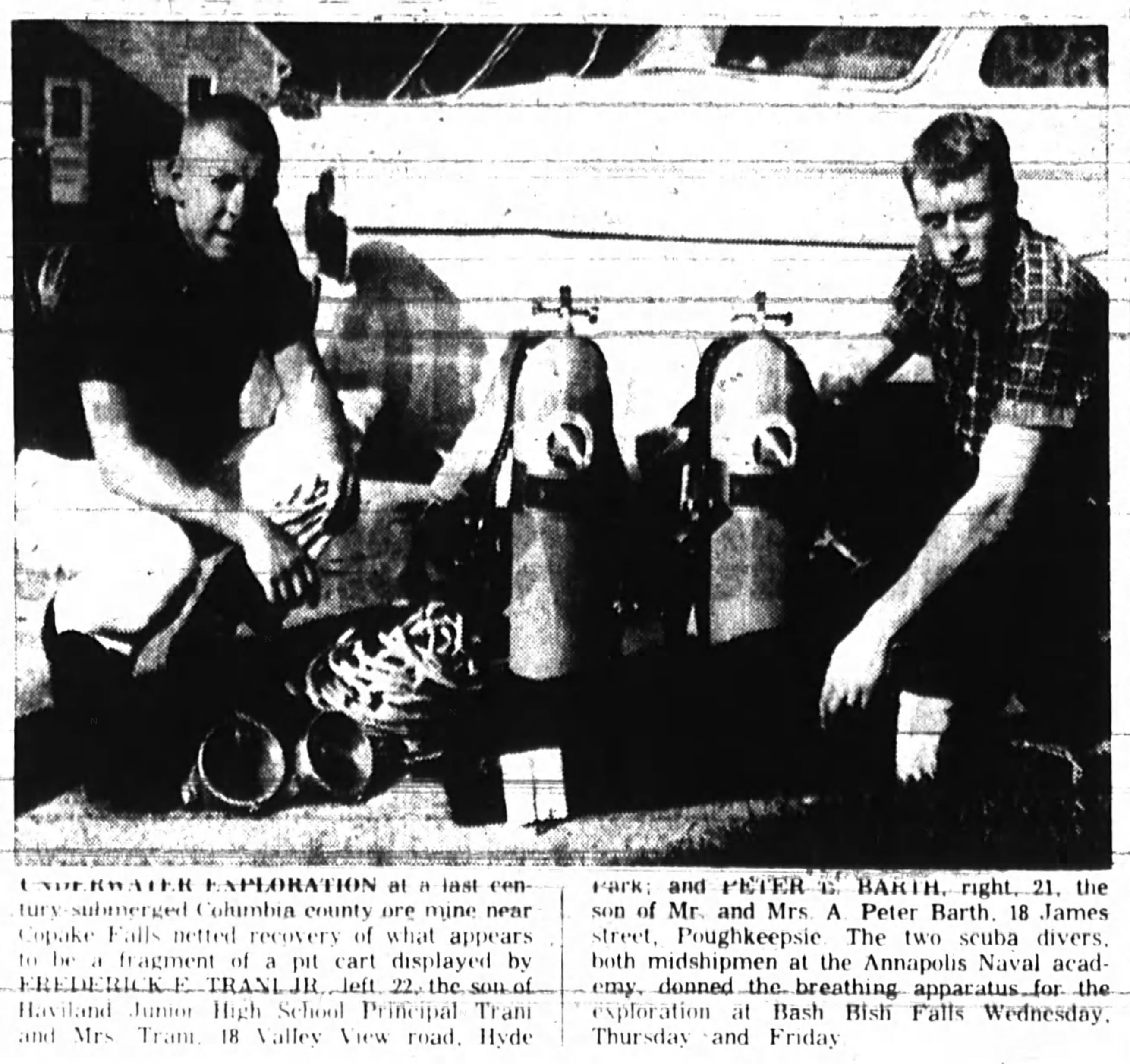
Donning underwater breathing apparatus last week for exploration of a submerged ore pit at Bash Bish Falls in Columbia county, Frederick F. Trani Jr., 22, and Peter I. Barth, 21, both midshipmen entering their fourth year at the U. S. Naval academy, became the first divers to pierce the darkened waters with scuba-gear to investigate rumors that the water hole contains a complete mining company.
With the permission of the State Park commission, Frederick and Peter descended approximately 40 feet and came back with fragments of what appeared to be a wooden pit cart.
Frederick, the son of Haviland Junior High School Principal and Mrs. Frederick Trani, 18 Valley View road, Hyde Park, became interested in the sport during underwater demolition training at the academy.
Peter, the son of Mr. and Mrs. A. Peter Barth, 18 James street, Poughkeepsie, acquired experience in the use of underwater apparatus while investigating caves in Florida.
Both swimmers were sponsored in the descents by Von Der Linden’s sporting goods store, 52 Market street. Using equipment and air from this store, both were able to explore the pit and substantiate part of the 75-year-old story that the mining company including carts, tools and several men remain at the bottom of the pit.
Frederick said that the story is told that an underwater spring was supposed to have broken into the mining shaft filling the pit before anyone could get out.
Diving in what appears from the surface to be a serene swimming hole, the swimmers encountered chilling water when they attempted to descend below 40 feet.
While both midshipmen plan to continue the exploration next summer while on 30-day leaves, they advised anyone attempting to descend into the pit to receive permission from the Park commission.
Signals and other safety precautions should be taken before diving into the hole. Another difficulty encountered is strong water currents.
Next summer the two countians plan to don insulated suits for protection from cold currents. Their objective is a complete exploration of the pit.
From the Montana Standard on August 22, 1967:
Culaodung Island, South Vietnam — “The Vietcong are really shook when we go into their backyard and hit them,” the blond, blue-eyed Navy officer said. “Well, we hit them and they know they’re no longer safe in the areas they control.”
Lt. Frederick E. Trani, 27, Hyde Park, N. Y., leaned back against the armor plating of the landing craft, his blackened face still tense from the raid he led on this Vietcong controlled island in the mouth of the muddy Bassac River deep in the Mekong Delta.
Trani is leader of a platoon of SEALS, the little publicized group of Navy frogmen trained in the art of infiltration and guerrilla style attacks, which they have been conducting quietly for eight months in the Mekong Delta.
The name SEALS is an acronym from the words sea, air, land, in all of which they have been trained to operate.
This week, the SEALS have launched their largest and one of their most daring raids. 20 men of the SEAL team and six South Vietnamese raiders swept onto this island where for five hours, they dynamited bunkers, burned houses and stores of rice, blew up sampans and killed three Vietcong who had failed to run. All others, some 200 men, had fled.
U.S. Navy river patrol boats are shot at continually whenever they pass near the island. The Vietcong use it as a major crossing point and staging area.
South Vietnamese troops have never penetrated the island, which has been considered too strong to contest.
Plans called for the SEALS to combine strength with local irregular troops for a night sneak attack by sampan down the Khembang Canel, one of two canals running the length of the island. U.S. Navy patrol boats had been into the canal only twice before, each time touching off hot fire fights.
The night raid was cancelled when trouble developed with an engine in one of the sampans, and for lack of coordination among the groups in the small boats.
The SEALS decided to go it alone with a daylight attack, backed by Vietnamese RAG (River Assault Group) boats and an equally strongly forti-armed helicopters.
At 8 a.m., after the frustrating maneuvering in the sampans through a sleepless night, the attack force assembled at the south entrance of the canal.
As bright sunshine warmed the morning air, the nine boats of the RAG force and the khaki colored U.S. Navy LCM “mike” boat landing craft steamed in line into the 150 yard wide canal into Vietcong territory. Heading the column was a mine sweeper. Interspersed were two heavily armored monitor boats and an equally strong fortified command boat.
Three of the Seawolves, circled overhead, darting ahead to scout the canal and the banks for possible ambushes.
For one hour, the boats moved slowly up the canal, the big mortars and machine guns spitting occasionally at the woodline on the shores. This island has long been declared a Vietcong stronghold and a free fire zone, which means anything on the island is an approved target.
At 9 a.m., Lt. Sam Braly, 28, of Tulia, Texas, officer in charge of the boats which support the SEALS, said tensely to the coxswain, “Turn in to the beach on the left.”
The heavy landing craft crashed through the thick undergrowth, the front ramp slammed down and out ran the SEALS, wearing black and their faces blackened.
Up and down the canal, the other nine boats put their bows onto the shores on both sides of the canal, to confuse any observers. From the commandant boat, camouflaged irregular troops poured ashore to protect the waterfront.
Heavy black smoke poured up amidst the thump of grenades and heavy explosives as the SEALS found targets, working a half mile inland. There they found an entire hamlet, with huge stock of rice, an obvious resupply center.
“We burned every house in that hamlet,” said Lt. (JG) William Bishop, 25, of Chicago. “Those VC are going to remember we aren’t afraid to come to them.”
Five hours later as a torrential monsoon rain pelted down, the SEALS came out, and back into the landing craft. One of the Vietnamese SEALS had been wounded in the leg by his own grenade fragment, the only casualty in the group.
“We destroyed 14 tons of rice, burned 53 houses, destroyed 14 bunkers and six sampans,” said Trani. “We found a prison in one house, with rings in the floor and newly cut thongs attached.”
“I guess the helicopters and the size of the RAG force frightened the VC away, that’s the only bad part. We only got three of them.”
Rick is buried in New York.
Remembrances
From USNA Class of 1963:
The following was received in January 2009 from Tom Murphy USNA 1962 and provides valuable information concerning our classmate Rick:
From May ‘68 to May ‘69 I was assigned to the Naval Advisory Group and stationed at My Tho with VNN River Assault Group 33 (RAG 33). I was on the operation in which Rick Trani was killed and in fact called in the medevac helo which got him to Dong Tam where he subsequently died of his wounds. For many years I have felt a need to share my knowledge of this event and the details surrounding it and the memorial which RAG 33 and 21 maintained at their base which also eventually included Rick’s name.I first met Rick in September 1968 when he showed up at the VNN RAG base with a half dozen enlisted VNN sailors. While they were being processed by base personnel Rick told me these were the first graduates of the new VNN SEALS (LDNN) and he had been assigned as their Advisor and instructed to take them into combat. He further stated that he had been told that RAG 21/33 was the best fighting force in VNN (it was!) and he thought he would start here. As we planned an operation Rick stated several times that he didn’t know these guys very well and he didn’t want to get them in over their heads–not ending up confronting a VC battalion somewhere as he put it! We finally worked up a small operation on an island off My Tho (I think the name was Toi San but my memory fails me here although I could find it on a map). VC “tax collectors” were known to use it as staging area and we planned to ambush one of their parties. When we took the plan to the VNN RAG CO he was unenthusiastic which surprised me because I had found him to be an aggressive and most competent leader on all of the previous operations we had shared. I guess he finally got directions through his chain of command to cooperate but he only assigned one of his JO’s and a FOM (one of our small escort boats) to support it. Since Vietnamese JO’s were usually not very fluent in English and not routinely used to independent responsibilities I decided to go along. It was the first and only time I went on an operation without my counterpart and the first time I had ever ridden in a FOM. Rick was able to recruit a US SEAL petty officer from the unit assigned to the PBR base next door to serve as his radio operator.
We inserted Rick and his team just after dark and then made a great show of moving off in the FOM before returning to await the morning extraction. We maintained radio silence until Rick’s radio operator contacted us that they were on the way out. Just as the first of his men was coming out of the tree line there was a loud explosion and a call from his radio operator that “Mr. Trani is hurt, hurt real bad!” I shifted my radio frequency to the big US Mobile Riverine Force base at Dong Tam about 7 km away to get a dust off helo en route. When I got back to Rick’s radio frequency I couldn’t get any information except that Rick was hurt bad, couldn’t make it out, and needed help from me “right now!” The helo was there in minutes, I shifted frequencies again to talk to him and popped a smoke grenade for identification. The helo was reluctant to go in but since I could hear no small arms fire I assured him it would be a cold pick-up and he finally went in and took Rick out. We finally extracted the rest of Rick’s guys and his radio operator and learned that there was a trip wire booby trap that each of his men passed safely by until Rick detonated it. I got to the hospital in Dong Tam the next day and talked to Rick. He was in good spirits and coherent although still listed as critical because of the possibility of a blood clot reaching his heart.
He told me they had ambushed and killed a VC “tax collector” party and retrieved several weapons and a fair amount of money (all of which later disappeared and to this day I’m sure his men stole). A day or two later I learned that Rick had died of his wounds.
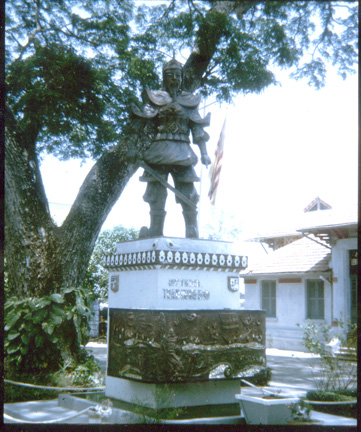
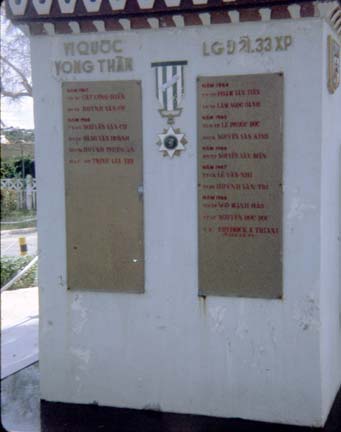
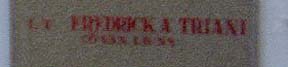
If you’ve read this far I’m grateful for your patience but I’m now at the point where I now want to pass along something else about Rick previously known only by me. Shortly after the events described above, my Vietnamese counterpart, who was very proud of our base appearance (it was actually quite elegant having been a former French yacht club) decided to erect a monument to our fallen VNN sailors from the two RAG’s stationed there. It was to be a larger than life statue of Tran Hung Dao, said to be the father of the Vietnamese Navy, with the names of our KIA listed on the pedestal. As I watched the work progress I decided that Rick’s name should also be included. I met instant opposition from my counterpart who insisted that only Vietnamese sailors should be listed. After weeks of fruitless discussion I stated that, should I end up a KIA I would expect to be included. My counterpart finally conceded the point that, since I was in fact an official member of the RAG, he would see that I was included. Given this opening I pushed that Rick was also assigned to the RAG on the day he was mortally wounded but again I got opposition. I even tried the “you owe me ploy” since the bags of cement used for the monument were stolen from the USAID warehouse by my enlisted advisor with my approval (I assume the statute of limitations has expired prompting this confession). Anyway, we shortly left for an unprecedented two week operation on the rivers and, on our return, my counterpart took me to the completed monument to show me Rick’s name now listed! I guess there is something in the Vietnamese psyche that they won’t do something unless it’s their idea. Anyway, in doing it themselves they misspelled Rick’s name!
Photographs
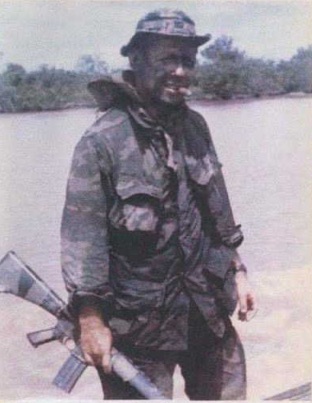
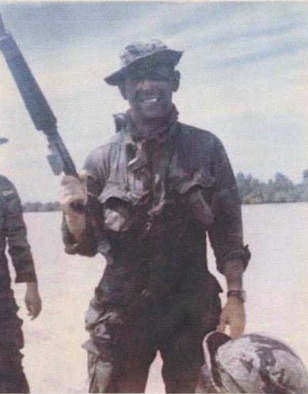
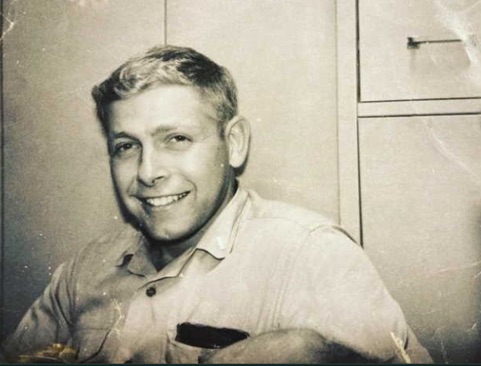
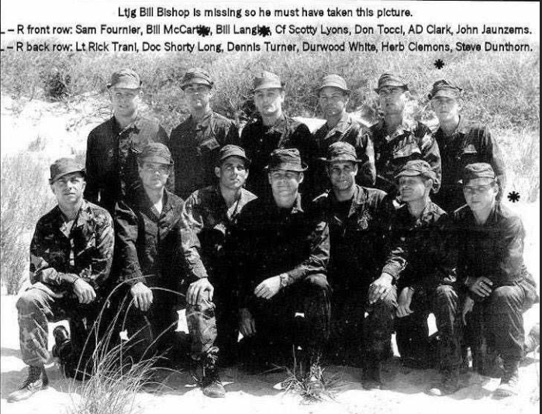
Silver Star
From Hall of Valor:
The President of the United States of America takes pleasure in presenting the Silver Star to Lieutenant Frederick Eugene Trani, Jr. (NSN: 0-669618), United States Navy, for conspicuous gallantry and intrepidity in action as a member of Sea Air Land Team TWO (SEAL-2), Task Force 116, while serving with friendly foreign forces engaged in armed conflict against Communist insurgent forces on the hostile island of Cu Lao Dung, Ba Xuyen Province, Republic of Vietnam, on 26 July 1967. While leading a small combat patrol, Lieutenant Trani, serving with SEAL Team Detachment Alpha, encountered and subsequently was surrounded by a numerically superior enemy force. Unable to maneuver out of the enemy encirclement, Lieutenant Trani attempted to contact supporting helicopters by radio, but before he could effectively communicate his unit’s position, he experienced radio failure. Undaunted by the lack of communications with supporting arms, he maneuvered his small unit into a tight defensive position. Though pinned down by constant enemy automatic weapons and rifle fire in a position that afforded only minimal protection for himself and his squad, and despite growing uncertainty of the arrival of assistance, Lieutenant Trani courageously moved among his men and succeeded in keeping morale high. Faced with a limited supply of ammunition and the imminent threat of a coordinated enemy attack that might easily overrun his small unit, he methodically employed every conceivable means to attract the attention of armed helicopters which he could hear operating in the distance. Four unnerving hours passed before the armed helicopters arrived to assist his beleaguered unit. Able to employ only primitive methods, he succeeded in marking his position for the helicopters and directed their fire onto part of the Viet Cong forces surrounding him. He directed another helicopter to a safe location to land for extraction of his unit. He then organized his men and maneuvered them under continuing enemy fire to the extraction craft without casualties or loss of a prisoner who later yielded valuable intelligence information. Through his exemplary and professional leadership, unwavering courage under fire and inspiring conduct throughout a desperate situation, Lieutenant Trani upheld the highest traditions of the United States Naval Service.
Action Date: 26-Jul-67
Service: Navy
Rank: Lieutenant
Company: Seal Team 2
Regiment: Task Force 116
Rick’s Silver Star was presented by Admiral John S. McCain, Sr., USNA 1906.
Legion of Merit
From Hall of Valor:
The President of the United States of America takes pride in presenting the Legion of Merit with Combat “V” (Posthumously) to Lieutenant Frederick Eugene Trani, Jr. (NSN: 0-669618), United States Navy, for exceptionally meritorious conduct in the performance of outstanding services to the Government of the United States while serving in the Republic of Vietnam from 15 May to 26 September 1968. As the Senior Advisor to the Vietnamese Navy SEALS, Lieutenant Trani provided advice and assistance to the SEALS in all matters pertaining to their training, utilization and administration. He participated in numerous combat operations and was often subjected to direct enemy fire. Through Lieutenant Trani’s keen insight and outstanding professionalism, the Vietnamese Navy SEALS were reorganized, equipped and trained to conduct unconventional warfare type missions throughout the Republic of Vietnam. Their motivation and performance during many difficult and dangerous assignments is directly attributable to Lieutenant Trani’s efforts. His devotion to duty, courage under fire and sense of responsibility were in keeping with the highest traditions of the United States Naval Service. (Lieutenant Trani is authorized the Combat “V”.)
Action Date: May 15 - September 26, 1968
Service: Navy
Rank: Lieutenant
Frederick is one of 29 members of the Class of 1963 on Virtual Memorial Hall.