LT ADDIS D. NELSON, USN
Lucky Bag Yearbook
From the 1921 Lucky Bag:
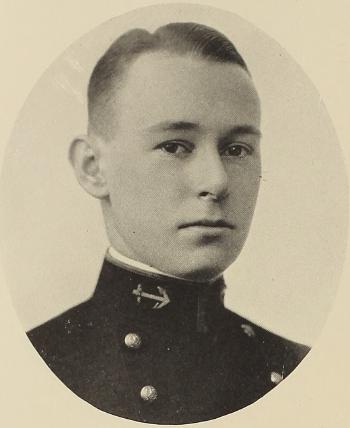
Addis Dewey Nelson
Gym Team (4); Tennis Team (3, 2, 1); Captain Tennis Team (1); Winner Thompson Trophy Sailing Race; Two Stripes.
LOOK him over, people. A true snake who conforms to the ancient rites and traditions of the favored brotherhood. Any Saturday night over at a hop, all you had to do was to look around the deck, and you could immediately pick out our dashing Addis from the remainder of the laboring swains. The only trouble is that he is so terribly bashful—that being one of the reasons why he didn’t go out for the gym team after he had become a nonchalant Youngster.
Our Nellie wields a deadly racquet, and as for sailing, he is a veritable old man of the sea. He is perfectly at home in calm or storm, but prefers to anchor during squalls. With a skag in his face and his hand on the tiller, he is in his natural element.
Besides his many other accomplishments, he has made many a night horrible with his violin. It’s wonderful what music can do for one. His friends still remain true, even after such a night’s session.
When all is said and done, he is a true and staunch friend and hasn’t an enemy in the Academy; and what more can be said?
“H—l, Jake! My hair’s coming out again.”
Loss
Addis was lost on November 9, 1927 when his airplane crashed into the Lafayette river “near 51st Street” in Norfolk, Virginia. (Information from death certificate.) He was a member of Fighting Plane Squadron (VF) 5S
From researcher Kathy Franz:
Addis was killed when his Curtiss Hawk S 6-C 3 collided with an Army Martin bomber, Keystone LD-5. The three men from the bomber parachuted to safety. Their plane clipped a rooftop before landing in the Lafayette River. Addis’ plane fell into Tanner’s Creek near the Country Club. He was still strapped in, so it was presumed he suffered his skull fracture when the planes collided.
Other Information
From researcher Kathy Franz:
Born in Winchester, Addis was raised in Brookline, Massachusetts.
Addis attended Brookline schools. He was appointed to the Naval Academy as first alternate by Congressman William H. Carter in September 1915.
Addis was a member of the Sigma Alpha Epsilon fraternity at Boston Tech (aka Massachusetts Institute of Technology, Class of 1920.) He was listed on the Roll of Honor in the 1919 yearbook.
He married Bessie Turner at the First Presbyterian Church on May 8, 1926, in Pensacola. She later married Douglas Turner Day, Jr.
His father Frank was a public accountant who was a direct descendant of Governor Winthrop of Massachusetts. His mother was Anna Dewey Nelson who studied at the Boston Conservatory of Music and was an accomplished soprano. His older brother Winthrop was a bank teller who had served in WWI in the Naval Reserve Force.
After serving on the cruiser Concord, the U.S.S. Florida, and other ships, he took the flying course two years before his death. He was a member of the Sigma Alpha Epsilon fraternity.
He earned his wings as naval aviator #3237 on September 11, 1925.
He is buried in Arlington National Cemetery.
Navy Directories & Officer Registers
The "Register of Commissioned and Warrant Officers of the United States Navy and Marine Corps" was published annually from 1815 through at least the 1970s; it provided rank, command or station, and occasionally billet until the beginning of World War II when command/station was no longer included. Scanned copies were reviewed and data entered from the mid-1840s through 1922, when more-frequent Navy Directories were available.
The Navy Directory was a publication that provided information on the command, billet, and rank of every active and retired naval officer. Single editions have been found online from January 1915 and March 1918, and then from three to six editions per year from 1923 through 1940; the final edition is from April 1941.
The entries in both series of documents are sometimes cryptic and confusing. They are often inconsistent, even within an edition, with the name of commands; this is especially true for aviation squadrons in the 1920s and early 1930s.
Alumni listed at the same command may or may not have had significant interactions; they could have shared a stateroom or workspace, stood many hours of watch together, or, especially at the larger commands, they might not have known each other at all. The information provides the opportunity to draw connections that are otherwise invisible, though, and gives a fuller view of the professional experiences of these alumni in Memorial Hall.
May 1923
July 1923
September 1923
November 1923
January 1924
March 1924
May 1924
July 1924
September 1924
November 1924
January 1925
March 1925
May 1925
July 1925
October 1925
January 1926
October 1926
January 1927
April 1927
October 1927
Addis is one of 28 members of the Class of 1921 on Virtual Memorial Hall.