LCDR CECIL Y. JOHNSTON, USN
Lucky Bag Yearbook
From the 1911 Lucky Bag:
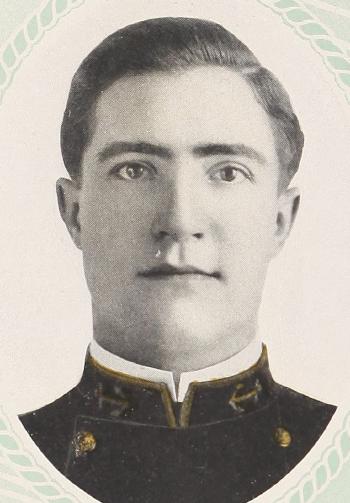
Cecil Younger Johnston
Red N; 2nd Red N.
Loss
Cecil died on December 18, 1924 of injuries sustained on December 6 when the aircaft he was piloting crashed on takeoff from NAS Hampson Roads.
Other Information
From researcher Kathy Franz:
In 1906 Cecil graduated from the State Normal School at Kirksville, now known as Truman University. He was a member and an officer of the Philos. Under Jokes in the yearbook: Lurah Loomis asked: “May I have the best part of your apple?” Cecil replied: “Yes, sure, here are the seeds, plant them and you’ll have a whole orchard.”
On May 9, 1908, Cecil rowed on the Naval Academy second crew which won over the second crew of Columbia University in a two-mile race on the Severn River.
In July 1912 Cecil returned from a South American Cruise in which his crew took Secretary Knox to South America.
In December 1913 Cecil was on one of the nine battleships that traveled 9,000 miles. The ships left Hampton Roads on October 25 for the Mediterranean without recourse to coal, oil or provisions at foreign ports. This was a record according to the Navy.
In April 1914 Cecil was on the Connecticut at the scene of trouble on the east coast of Mexico.
In March 1918 Cecil was on a tour to different cities to arouse more interest in the work of the Navy. After visiting in Kirksville, he and his father went to Kansas City.
In March 1919 Cecil’s submarine made 3,700 miles in twelve days without a stop with 200 miles being through a storm. This was a new record for speed and endurance.
In January 1920 he was living at the Army and Navy Club in Washington, D. C.
Cecil’s father John was a school teacher, and his mother was Sarah. His sisters were Gertrude (Mrs. Oliver Stigall,) Elizabeth “Bessie,” a teacher and traveling saleswoman for a publishing company, and Caltha (Mrs. Andrew D. Pierson.) His brothers were Richard H. (non-grad Class of 1902) who worked for the Bureau of Budgets in Washington D. C., and Leon, a professor of mathematics at the Naval Academy in 1920 and at the University of Pennsylvania.
From the Nimitz Library at the Naval Academy:
Cecil Younger Johnston, brother of Richard Howard Johnston and uncle of John Porter Merrell Johnston, was born on June 20, 1889. Johnston entered the United States Naval Academy on July 8, 1907 as a member of the Class of 1911. Upon completing the academic course at the Academy, Johnston was assigned to U.S.S. Washington (Armored cruiser: ACR-11), U.S.S. Rhode Island (Battleship: BB-17), and U.S.S. Paducah (Gunboat: PG-18). In August 1913, he was attached to U.S.S. Connecticut (Battleship: BB-18) as Fire Control Officer. Following seven months of duty aboard U.S.S. Ozark (Monitor: BM-7), Johnston was detailed for submarine instruction in January 1915, after which he assumed command of U.S.S. G-3 (Submarine: SS-31). In March 1918, he assumed command of U.S.S. R-16 (Submarine: BB-93). Beginning in September 1918, Johnston received flight instruction in Coco Solo and San Diego, after which he was detached from U.S.S. R-16. Further flight instruction followed in January 1921, as well as radio instruction at Naval Air Station Anacostia later that same year. In December 1921, Johnston assumed command of NAS Anacostia, with additional duty as Naval Aide to the White House beginning in February 1922. In June of that year, he was transferred to U.S.S. Wright (Aircraft tender: AV-1) for flight duty with the Scouting Fleet. In November 1924, he was transferred to Naval Air Station Hampton Roads. On December 6, Johnston’s plane crashed on takeoff from NAS Hampson Roads. While initially receiving a good prognosis, Cecil Younger Johnston succumbed to his injuries, dying on December 18, 1924.
Cecil is buried in Arlington National Cemetery.
Photographs
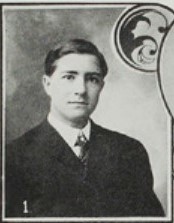
Navy Directories & Officer Registers
The "Register of Commissioned and Warrant Officers of the United States Navy and Marine Corps" was published annually from 1815 through at least the 1970s; it provided rank, command or station, and occasionally billet until the beginning of World War II when command/station was no longer included. Scanned copies were reviewed and data entered from the mid-1840s through 1922, when more-frequent Navy Directories were available.
The Navy Directory was a publication that provided information on the command, billet, and rank of every active and retired naval officer. Single editions have been found online from January 1915 and March 1918, and then from three to six editions per year from 1923 through 1940; the final edition is from April 1941.
The entries in both series of documents are sometimes cryptic and confusing. They are often inconsistent, even within an edition, with the name of commands; this is especially true for aviation squadrons in the 1920s and early 1930s.
Alumni listed at the same command may or may not have had significant interactions; they could have shared a stateroom or workspace, stood many hours of watch together, or, especially at the larger commands, they might not have known each other at all. The information provides the opportunity to draw connections that are otherwise invisible, though, and gives a fuller view of the professional experiences of these alumni in Memorial Hall.
January 1912
January 1913
January 1915
January 1916
January 1917
March 1918
January 1919
January 1920
January 1921
January 1922
May 1923
July 1923
September 1923
November 1923
January 1924
March 1924
May 1924
July 1924
September 1924
November 1924
Cecil is one of 15 members of the Class of 1911 on Virtual Memorial Hall.